Author Archives: Dina Coppel

Unknown's avatar

About Dina Coppel

Focused on elevating governance and women at all levels of business to improve performance

Reflections at the halfway mark

Yesterday we hit the halfway mark in our trip. For those not aware of our plans or planning, we will be travelling for six months. It is a wonderful experience, but not without its challenges for such a long period.  We had planned the first nine weeks and after that were going to “work it out on the road”. Our first big picture plan had to be adjusted when we learned we were not allowed to take our car into the Balkans. After a day or two trying to find ways around it, we modified our plans. We usually plan about a month ahead, but slowly. This allows us to change our minds on where we should stay, based on the recommendations of friendly waiters….true story!

We spent last evening reflecting on the things we have learned on our trip so far…..
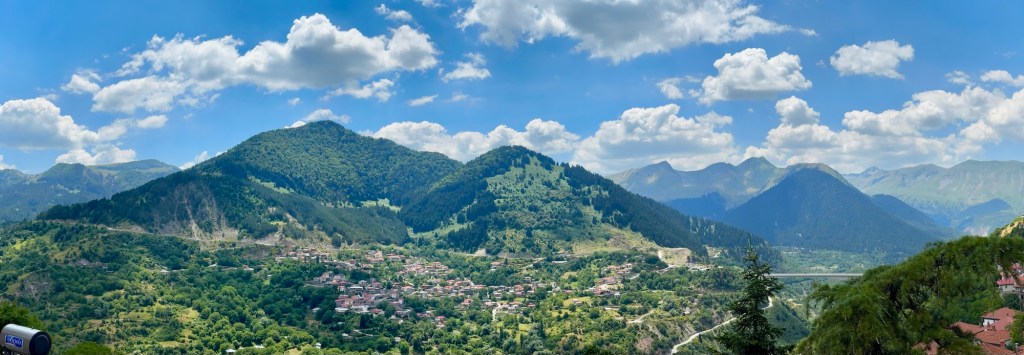
  • Having time provides us with a great opportunity to explore places that are off the usual beaten track and perhaps less well-known. As I write this, we are almost at the end of eight days in the northwest pocket of Greece, high in the mountains. This is an area packed with ancient stone villages, beautiful lakes, steep mountains and gorges. Some of the scenery looks like we could be in any of the mountain villages of Europe, although constant presence of Greek food does remind us where we are. It is not the easiest place to travel to but it has been a wonderful place to visit – with interesting history, beautiful scenery and warm hospitality. This is a different way to travel compared to squeezing a trip into a couple of weeks and we feel very privileged to be able to do it this way.
  • Moving every few days is exhausting. We packed the first couple of months with continuous moving from place to place. Two or three nights in an Airbnb is too short on a consistent basis. We arrive in the afternoon and spend the first afternoon working out our new environment, the second day looking around and then we are off again. We have since slowed down the pace, staying for five nights at Airbnbs, and if we stay somewhere for a shorter period, we have booked hotels. We have also repacked, so we don’t have to access all our bags when we stay in hotels (it’s pretty difficult to travel superlight for a six-month period).
  • The first day at a new Airbnb or village is the hardest. Not without me having had a couple of “moments”, we now know that when we first arrive it is not always as we expected it to be. It might be that we didn’t think about the location well enough, that some things don’t work the way we expect, or just that we may be tired from the travelling to get there. It is usually better by the second day, and we have learned to adapt and find ways to make everywhere work for us.
  • On that note, interpreting Airbnb descriptions (or the absence of a description) is an acquired skill. We look for “fully equipped kitchen” in the comments, air-conditioning throughout, how far it is from where you want to be (or not too close to where you don’t want to be). We check the photos to see what the kitchen is like, is there a couch and, in Italy, is it not right next to the kitchen table. Even then, one can’t always be sure that the three-bedroom, two-bathroom place doesn’t mean that one of the bathrooms is out the back and one must go outside to access it!
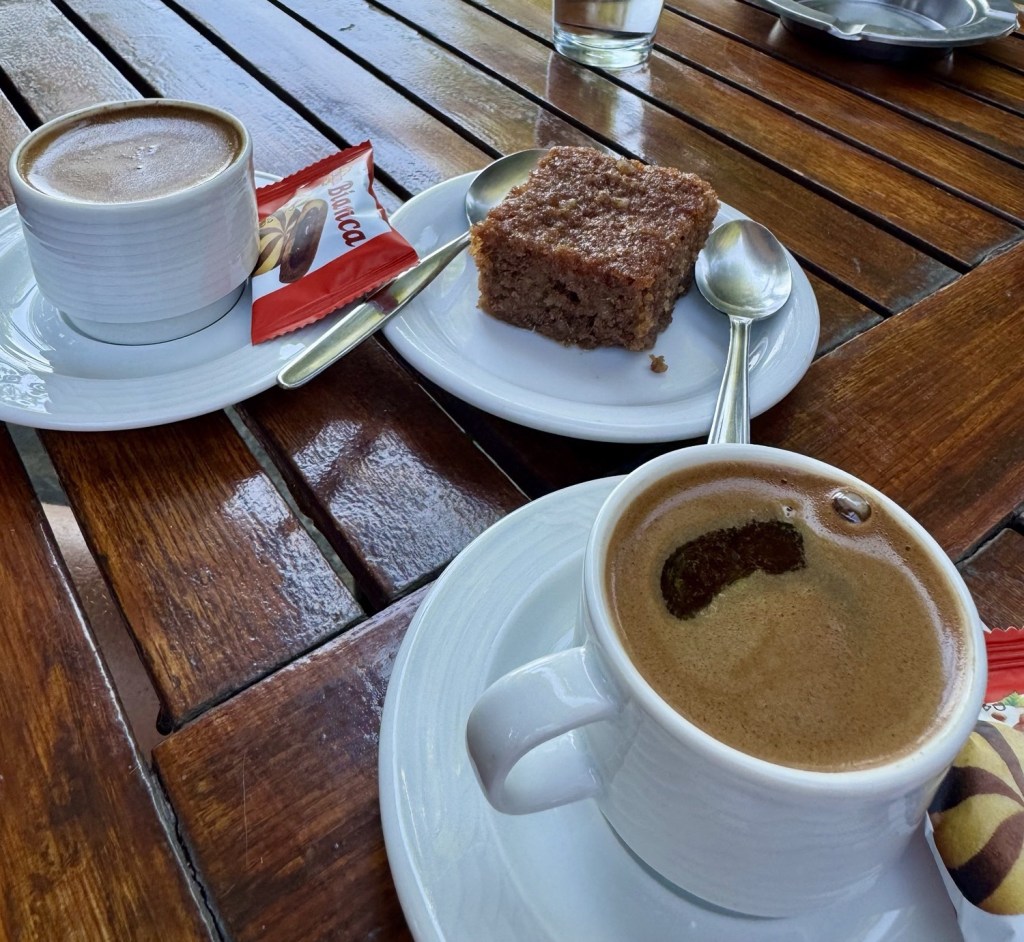
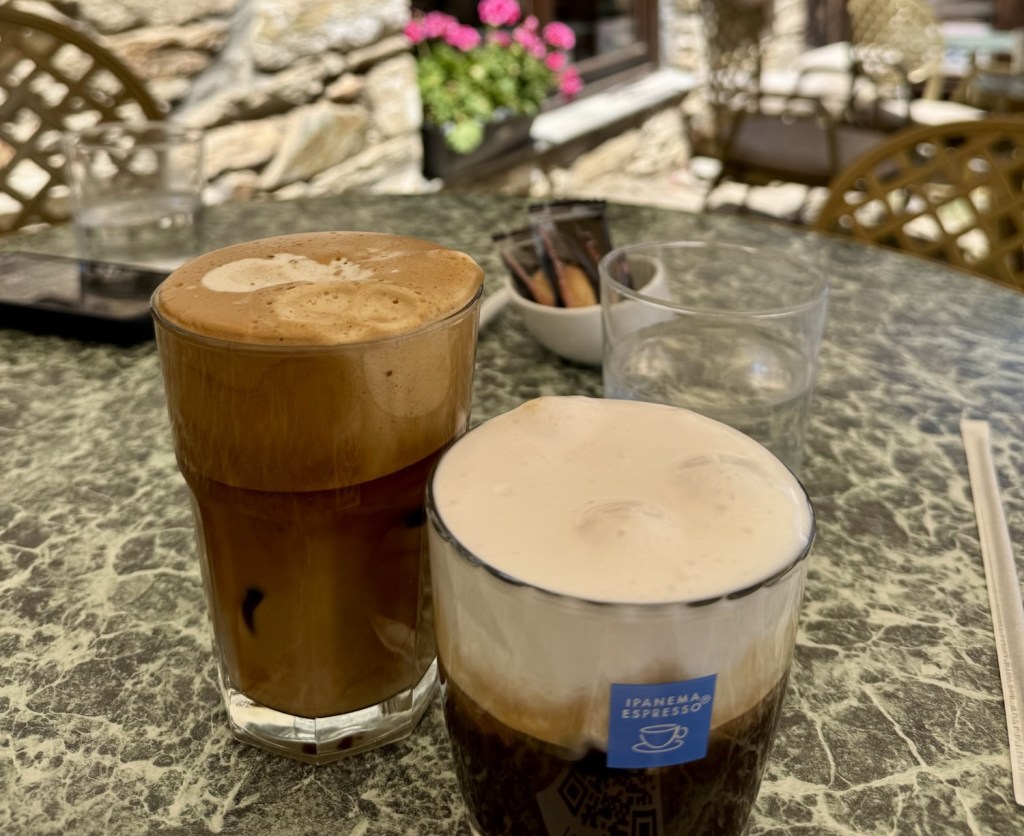
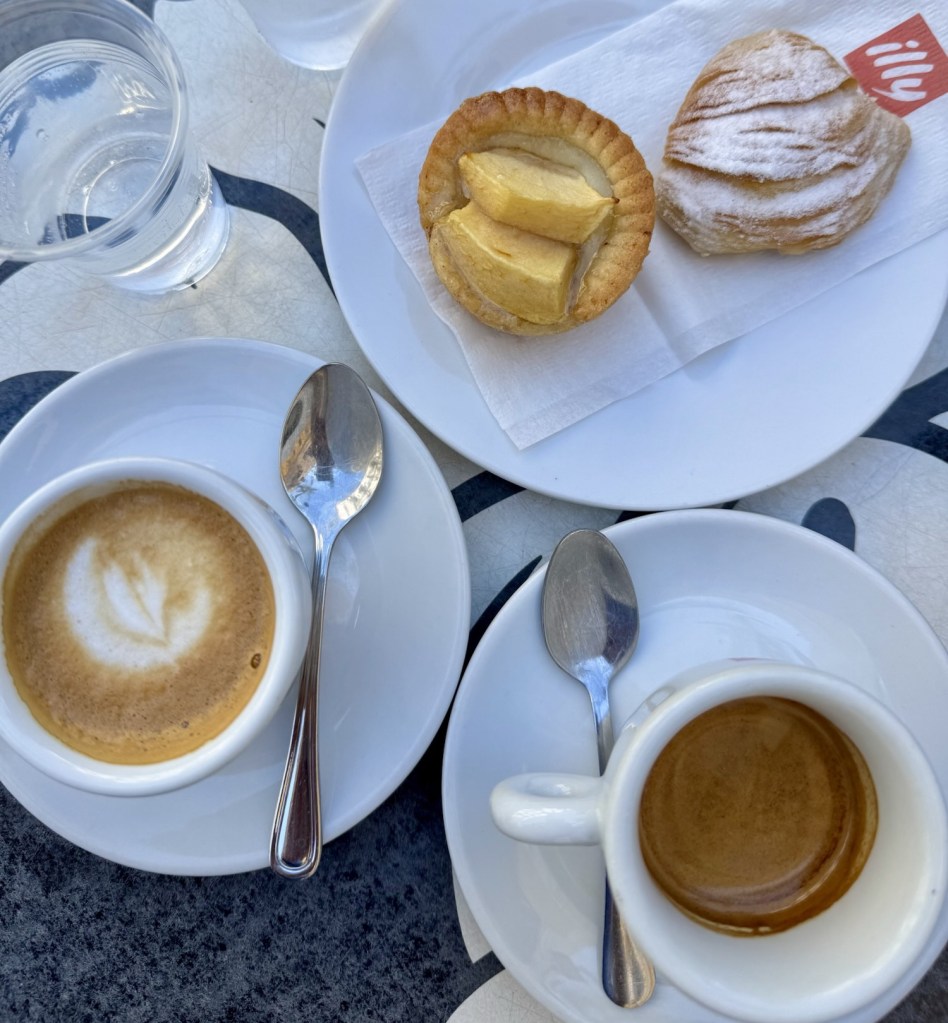
  • Coffee: A “piccolo latte” in Sardinia is a “noisette”. Italian espressos are very short and cheap, a double espresso costs double and a cappuccino at least three times the cost of an espresso. Greek coffee needs a little sugar, and freddo cappuccinos are fabulous, but need stirring before drinking. Coffees in Greece always come with a complimentary biscuit or piece of cake. In both Italy and Greece, coffee comes with a glass of water – perhaps to balance the effect?
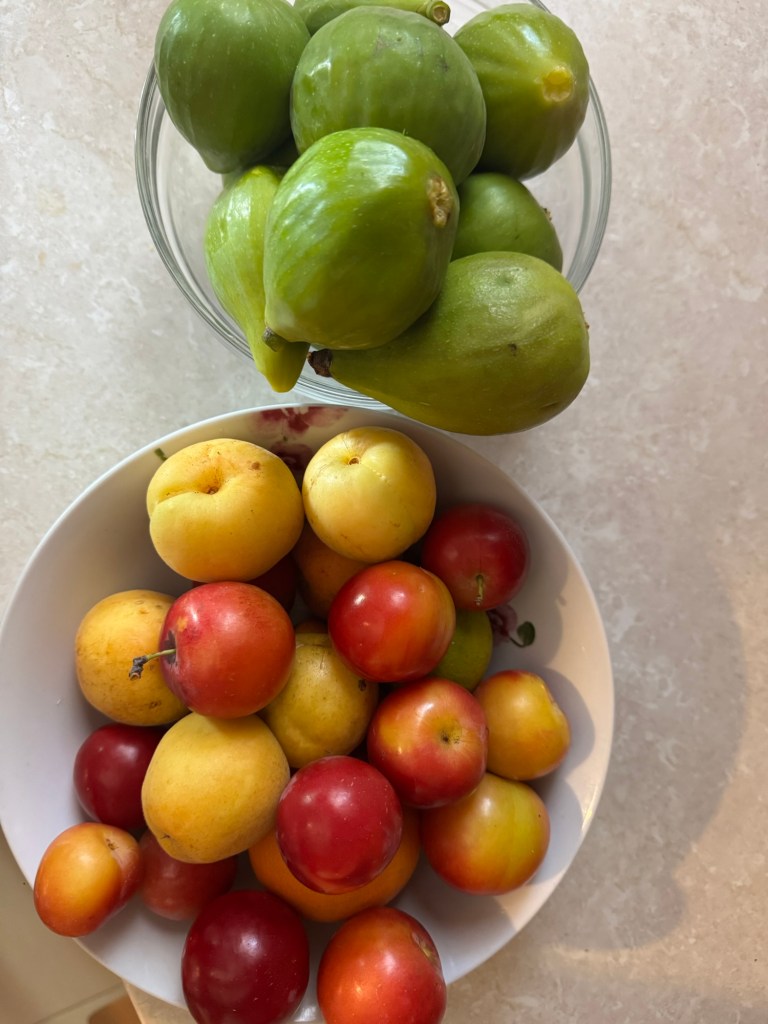
  • There is nothing quite like eating fresh fruit, picked off the tree – cherries, figs, kumquats, plums, apricots, oranges, mulberries and red currants have all been sampled. Fresh potatoes, cooked straight after being pulled out of the ground bring a whole new respect for the starchy tuber. And the other local vegetables such as tomatoes, peppers (pointy capsicum), eggplant, onions and garlic sold by the local truck that pulls up on the side of the road, taste magnificent. These fresh fruit and vegetables make dreaming up recipes an easy delight.

  • The European siesta now makes perfect sense. It may have been colder for longer than we expected but summer then started with a bang! By about 2pm it is far too hot to be outdoors. We head inside for a late lunch and then stay inside in air-conditioning until about 7pm when it starts to cool slightly. It is bright until close to 9pm when we realise it might be time to think about dinner. I still haven’t learned to sleep well on a full stomach when we finish dinner after 10.30pm.
  • Food/meals we have discovered we love – 
    • Baked feta
    • Galaktoboureko (Greek custard pie)
    • Sfogliatelle (a pocket of filo pastry best filled with ricotta) – but only on the day they are made
    • Tropean onions – long sweet red onions, amazing cooked with spaghetti or in onion tart, but lovely raw as well
    • Greek Orange cake
    • There is nothing that extra virgin olive oil doesn’t make better
    • Bruschetta with fresh plum tomatoes, basil and EVOO
    • Negroamaro – the red wine grape of Puglia
    • Limoncello Spritz (for Dina anyway)
  • Navigating Italian petrol stations requires patience and a preparedness to accept that what worked at the last place is not likely to work at this place. Having realised that self-serve prices are significantly lower than the serviced pumps, one must make sure to drive next to the correct pump. Then one must understand that if you can get the machine to accept your credit or debit card (not always the case for no apparent reason), it will charge the card €105 no matter how much the petrol costs! I had to have it explained by the lady at the counter (in Italian) that tomorrow I would be charged the amount the petrol costs and then credited the €105. Phew! At the machine, one version asks you to select the pump first and then give your card, another wants the card first and then select the pump. No surprises that not all the machines have an English translation, so I almost paid for someone else’s petrol at one point. Luckily, the kind man realised I was a flailing tourist and cancelled the transaction for me. In retrospect, it made the issue of trying to pay for petrol in Israel with a non-Israeli card not quite as traumatic. Thankfully in Greece we are back to being served at the bowser for the same price and paying the cashier.
  • It is wonderful to not have to set the alarm for 5am, to not have to jump out of bed when one does eventually wake up and quite a shock to the system to have to set the alarm occasionally for an early hike.
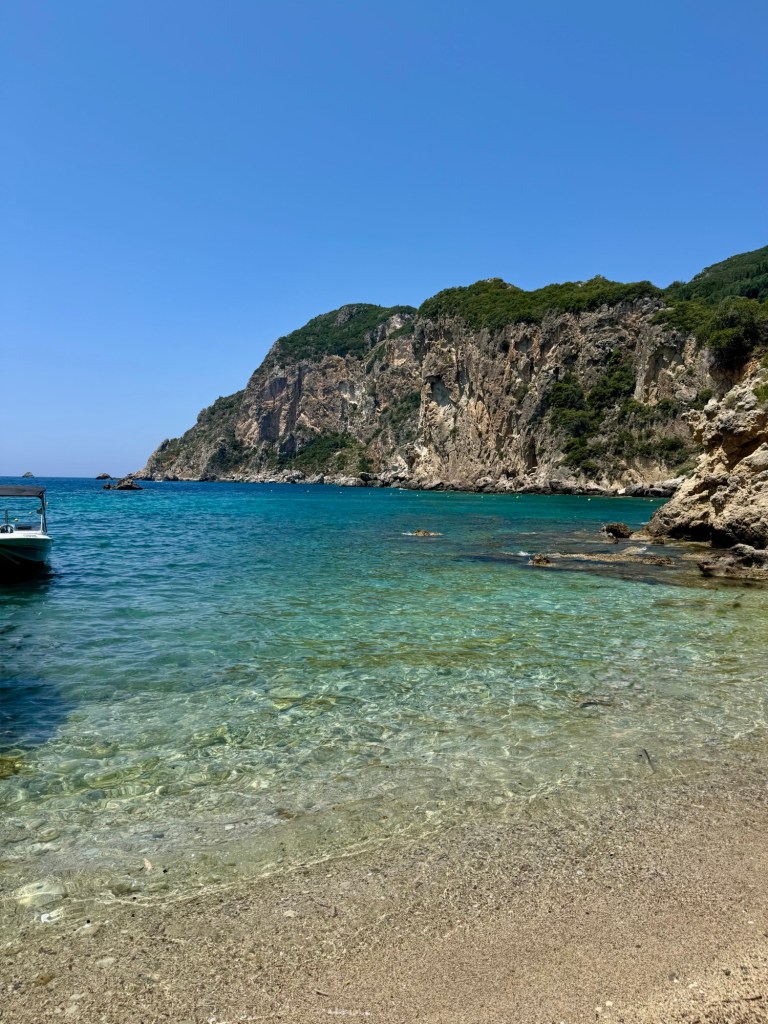
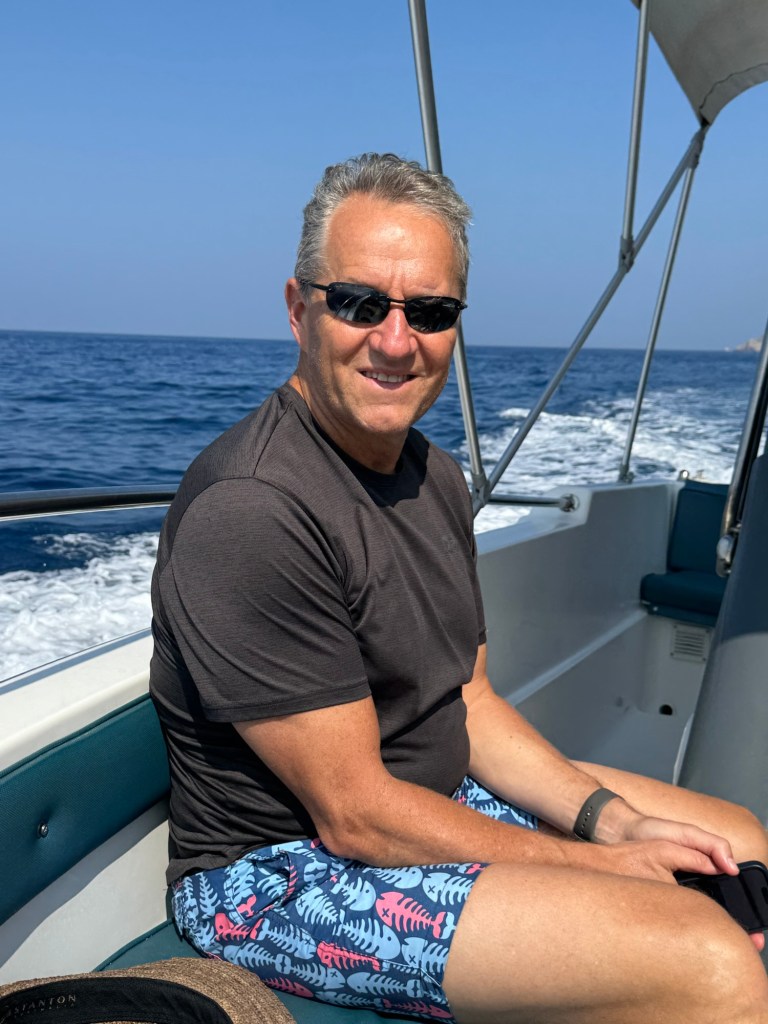
  • Perhaps partially because of the pace mentioned in my first point, it took ten weeks for Kevin to stand in the clear water at the beach in Corfu beneath cloudless bright blue skies, turn to me with a smile and say, “it beats working”.  He hasn’t changed his mind yet. 😊
Life in Liapades

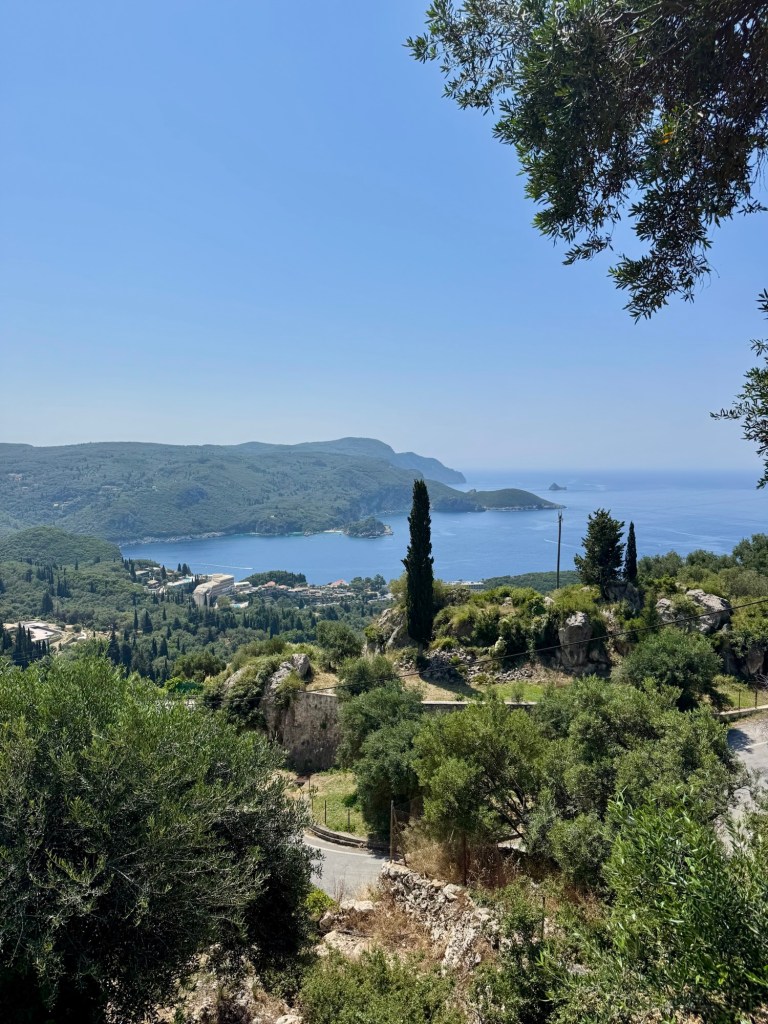
Last year, when talking about this trip, I would say to people: “Our ideal village to stay is one that has two cafes and a bike shop”. And here we are, on the western coast of the island of Corfu, staying in the village of Liapades (pop. 916), which has two cafes and a bike shop. Except that the bike shop rents motorbikes, not bicycles as we had envisaged!

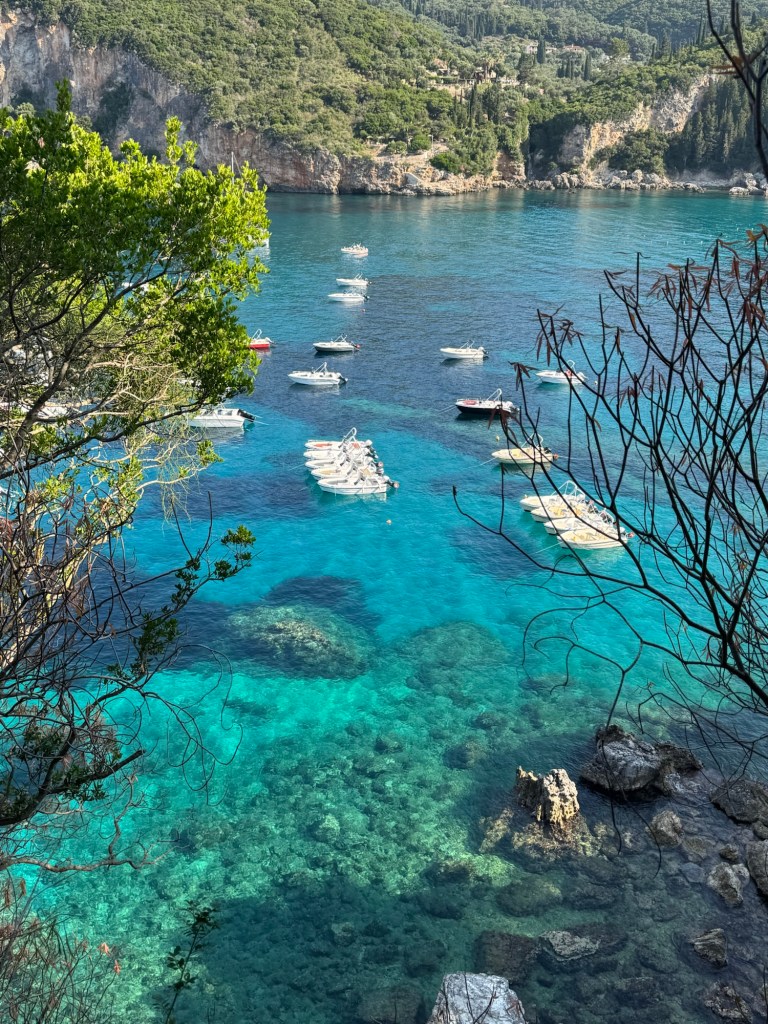
Liapades also has three churches, three minimarkets, three bars, two bakeries, two boat hire companies and a much larger number of family run restaurants or tavernas. It is positioned at the end of a gorgeous bay, with a stone covered beach surrounded by cliffs, with several little beaches, one more beautiful than the next in the coves around the bay and beyond. The nearest beaches are arrived at by walking down a steep path to the water level, allowing for views of the most iridescent turquoise and blue water on the way. Once at the beach, the water is crystal clear and while it becomes very deep very quickly, it appears much shallower as one can see all the way to the sandy bottom just a few metres offshore.

This is a place where the Mediterranean lifestyle and demeanour surrounds you. The first afternoon when we went to the bakery at the end of the lane which leads to our place, the baker had sold out of bread. We made a point of going back the next day in the morning, only to find that he only accepted cash and we didn’t have the €4 our loaf of bread and pastry cost. “Don’t worry”, the baker says. “You can pay tomorrow.” And so we did.

The hosts of our Airbnb, George and Katerina, live in the upstairs of the house we are staying in. They were both there to meet us, having happily agreed to allow us to arrive at 10am as we had caught the overnight ferry from Puglia in Italy. They both work in hospitality, clearly the main industry and employer in the region – she during the day and he does the 4pm to midnight shift. The house is surrounded by fruit trees, and they couldn’t have been more welcoming and generous in providing us with initial provisions and insisting we help ourselves to the fruit at any time. Each day we find fresh produce on our doorstep: lettuce one day, the next day fresh eggs and apricots, then plums and more apricots. We have also enjoyed kumquats, mulberries, figs, cherries and tiny plums from the tree.  George’s parents tend the garden and vegetable patch next door and each day his father greets us with a warm smile and a greeting of “Kalimera” (good morning). Having offered us fresh potatoes three days in a row, he was delighted that we accepted the offer today, foisting on us three times as much as I would have selected for myself. 

I cannot express the delight of the opportunity to prepare food with these fresh ingredients. The potatoes went into a warm potato salad with rocket, parsley, red peppers (the tastiest I have ever eaten) and a pesto mayonnaise dressing. The fresh eggs and apricots became the key ingredients of a twist on a Greek galaktoboureko or custard pie, with orange syrup instead of lemon. The plums, cherries, apricots and more make their way into fruit bowls for breakfast, with real Greek yoghurt on top!

Having taken a lot longer to get warm than we expected (and apparently than everyone in Europe expected), summer has now arrived in full swing. The days here warm up very quickly. I have taken to walking 1.3kms down to the beach, swimming for almost 2kms in the sea and then walking back with Kevin, who in the meantime has run up and through and around the village down to meet me at the beach as I finish my swim. By the time we have enjoyed a leisurely breakfast it is late morning. If we head down to one of the beaches, we can’t stay out for too long. For probably the first time in our lives, we appreciate the necessity of the beach umbrella our hosts insisted us taking to the beach. We might not finish our late lunch until 3pm and by 7pm we are asking each other where the day has gone – even though it is still bright outside. 

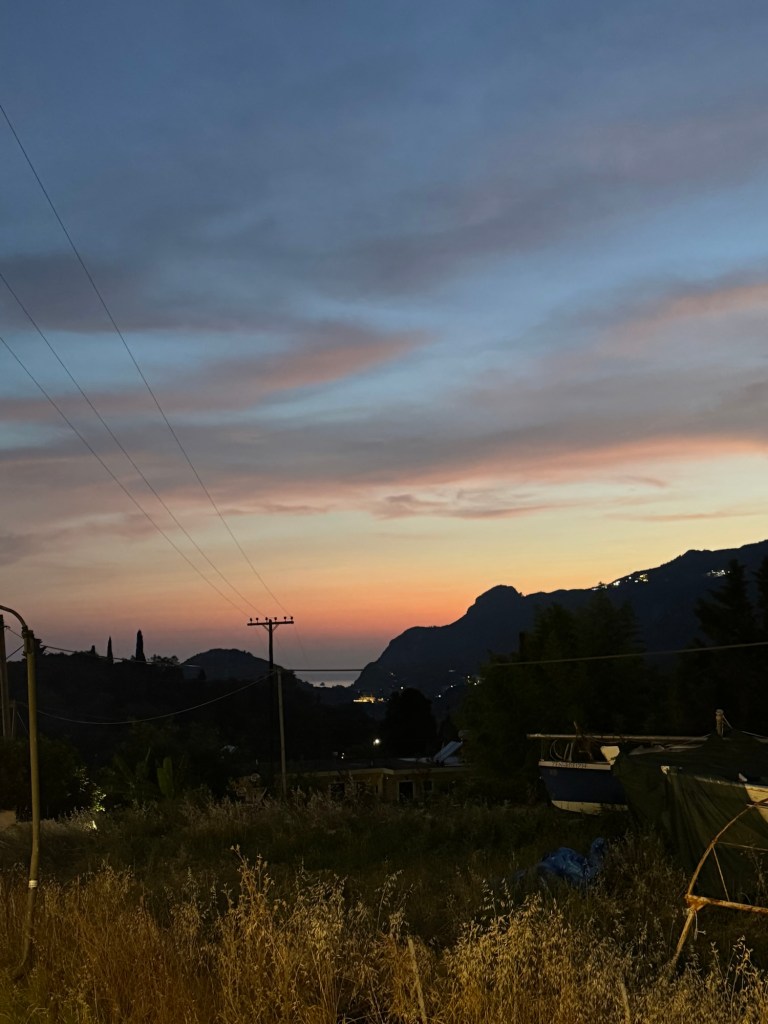
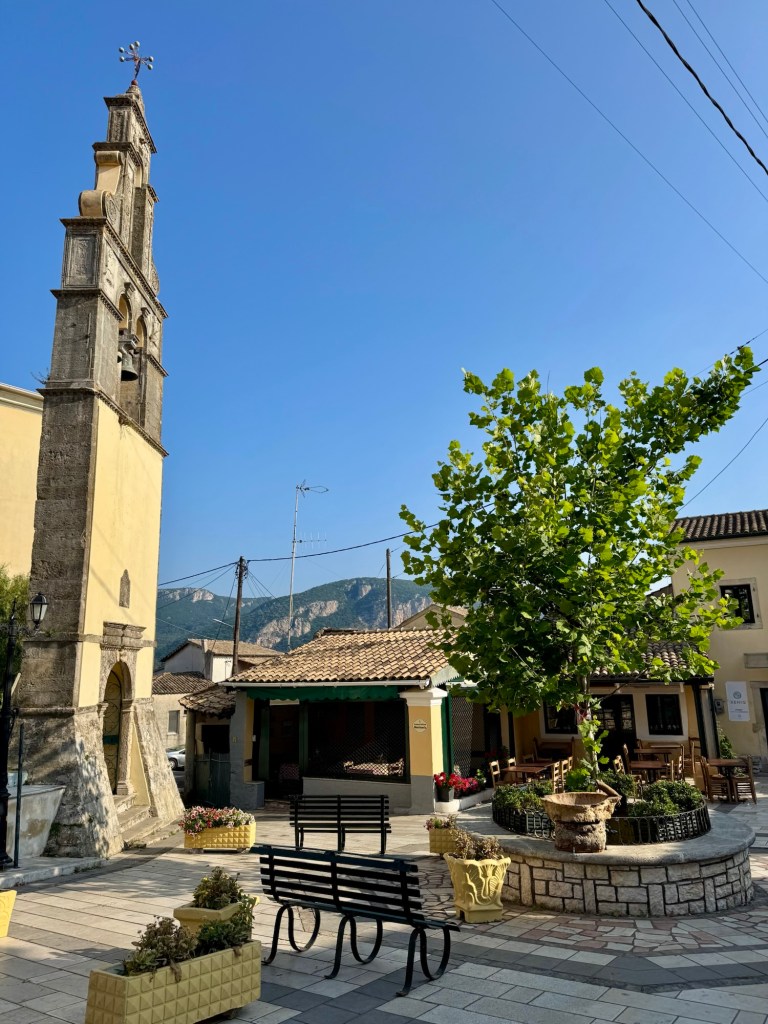
So we find ourselves walking out for dinner after 8.30pm, with the sky slowly changing from a pale blue to yellow, orange, pink and then purple before the light eventually disappears at about 9.45pm. On our first night we ventured into the bigger and more touristy village next to us for dinner by the sea, but our more relaxed and authentic meals have been at two of the tavernas in Liapades. One of them faces onto the “main” square up in the old village, made up of the taverna, two bars where many of the old men of the town congregate outside to sit and chat, and a church. 

The taverna was a family affair. The sons were waiting tables with warm generous smiles, the father was managing the service and mother and daughter were doing the cooking. The food was delicious, the service warm and the turnover of tables substantial as regulars and tourists would wait patiently in the square for a table to become free. Watching life in the village square occur at the same time was certainly part of the fun. 

The other taverna sampled so far is the “Fish Taverna” of the village, once again a family affair. This time the courtyard where we sat was covered in vines and the outlook was through the valley down to the beach, with gorgeous vermillion skies as a backdrop. Here the simple food far exceeded our expectations. Baked feta with tomato and oregano, tzatziki thick with cucumber pieces and rich yoghurt, sea bass grilled to perfection and sardines crisp and juicy at the same time – both accompanied by perfectly boiled potatoes (which probably came from the garden next door) and a very drinkable local rosé wine. We thought we had no space to order dessert, but we were able to make space for the delicious complimentary yoghurt mixed with honey and orange. 

Tomorrow the sun will come up again and beam down its hot and strong rays. We are planning to take a boat tour around this area of coastline and see all the hidden spectacular beaches and then have the boat drop us at one of them for a couple of hours. We are finally leaning into the slower, holiday mode – but how we are managing that process is for another time….

15 June 2025

More women on boards needs action not just discussion

pouring coffeeIt was great to see 24 female board directors in Singapore recognised recently at the Singapore Institute of Directors and BoardAgender‘s launch of “Women on Board: Making a Real Difference”. However, there’s still a way to go. There are lots of things that can help move the dial to increase the number of women on boards.  Here are three actions that can be taken:

·      According to Simon Israel, Chairman of SingTel and Singapore Post, “men need to get the religion” and understand that good governance, including diversity, is good for business and for value creation. With 27 of the top listed 100 Singapore companies not having a woman on board – it is the men on these boards that needed to be in the room today and they need to keep hearing it from their fellow male directors. Male champions need to speak to their fellow men.

·      Professor Lawrence Loh of National University of Singapore pointed out in his summary of the ASEAN Corporate Governance scorecard, that the longer the tenure of independent directors on a board, the less female directors there were on that board. The implementation of capped maximum tenures would not just make more spots available for women, it would ensure companies’ boards are refreshed with new perspectives and adapt to the changing external environment.

·      The myth of there not being sufficient capable women to serve on boards should be dispelled with SID Chairman Willie Cheng pointing out that there are more female members of SID than there are SGX listed boards without women. Female directors need to introduce other female directors to share and increase the roles (where 3 women on a board is an ideal number). Men and women all need to be aware of their unconscious biases and focus on skills and capabilities rather than expectations based on past experiences.

There’s definitely a change in the wind – but it will need action rather than just words for the change to take hold.

Coffee count: 611 coffees

Overcoming the knocks that take you off the road

bumped coffee 3For anyone who has a social media profile or has thought about establishing one, the key thing everyone tells you is that you have to post regularly. So, as I observe that there has been a gap of just over a year since my last post on this blog, I give thanks to you for still reading, particularly if you might have been a follower from sometime between early 2013 when I started and late last year when I last posted.  The gap is significant and the return is overdue, but as I reflect, I can’t help but draw the analogy between life events, work plans and lessons learnt from others during this time.

Not long after my last entry on this blog, at a time when many were still wondering what the implications of a Trump presidency would be, two heartrending events occurred in my own life, throwing me off the proverbial track.  One was the unexpected loss of my father, who was a mentor and advisor to me and a constant source of inspiration.  Before I had time to come to terms with this gap in my life, my husband was literally knocked off the road while on his bike, and sustained major physical injuries. Understandably, my focus became helping him to recover his health and normal life. Thanks to his determination and resilience, he is healthy and well again and is focused on resolving the last of his injuries in order to achieve a full recovery. While his resilient spirit and refusal to be a victim and to get back to normal life as soon as possible were a major contribution, so too were the team of medical specialists and family and friends who supported him. He could not have returned to riding and work if it hadn’t been for this external assistance.

Over a period of a few months this year, I have also had the chance to work with a group of dedicated individuals who serve on the board of a profit-for-purpose organisation.  I say dedicated, because this group of directors could see that the organisation was struggling and they were afraid that it might stray off the road and come to grief, undoing years of valuable contributions, and adversely affecting many stakeholders.  They sought an external perspective to review their strategy, organisation and processes. The resulting feedback and revelations that explained why the organisation, and particularly the board, had come to this position, gave rise to a number of challenging conversations at board level.

To their credit, the directors persisted, making difficult decisions and hearing realities that were not always comfortable. They listened and discussed, regrouped and then focused on what the organisation was there for, who it served and what that really meant.  With their vision clearly articulated, the directors are now doing what a board should do: setting the strategy and culture of the organisation for the future and taking the stakeholders with them on the road to future success.

Having a goal is what it is about. Having a vision of what you want to achieve, or what you stand for, who you want to be, or what kind of work you want to do.  It doesn’t really matter how specific the vision is, especially in this age when what we might be doing in 10 years doesn’t exist yet today. What matters is having a vision or a goal.  For life throws curved balls in numerous forms – careless drivers, disruptive technology, relocation and all other kinds of things that can knock you or your organisation off the road you are on.  The trick is to keep focusing on the outcome or vision that you want for yourself or your organisation, and finding both the inner resolve and the external support you need – whether it be family, friends, mentors or experts – to help you move back on a path to achieving that vision.

Coffee count: 585

PS These blog posts will in future also appear on my website elev8advisory.com

The problem with “likes”

like-coffeeFor some years now, we have been living in a society where people don’t like to upset others. One might question whether “political correctness” has gone too far when we can’t have Christmas decorations at a public school for fear of upsetting non-Christian students and in many schools kids are taught that “everyone’s a winner”.

Well the results of the recent US election prove that not everyone’s a winner. Not just Hillary; thousands of people have demonstrated against the results of a democratic election because they didn’t get the outcome they wanted. They didn’t like the result.

While clearly Donald Trump and others have decided to throw political correctness out the window, it may well be much harder than that to escape from. The widespread use of social media has perpetuated political correctness in our lives. On Facebook, Instagram, Twitter and LinkedIn we have all become used pressing the “like” button. Only on YouTube are you able to give a thumbs-downif you don’t like something. My kids tell me that this is to avoid bullying online, but we all know it doesn’t need a “thumbs down” for bullying to take place on social media.

One of the effects of “liking” something on social media is that we are then led to other like-minded posts or sites. Algorithms are designed to suggest “other sites you might like”. And so, we can easily found our screens filled with information that confirms or strengthens the first idea, proposition or statement we liked.

This confirmatory process has implications for our children, society generally and our business leaders.

Our kids today have more information literally at their fingertips than they will every need. Their challenge is not to try to find the information but rather to discern bias, truth or otherwise, fact from opinion rather than just accepting what they read or believing that the first three “unsponsored” entries on Google are correct.

Another implication of only hearing and reading what we “like” is that we become affronted when we see something we don’t like – leading to a lack of resilience. We have people in democracies demonstrating against the results of free elections. We have trigger warnings being brought into universities in the US, UK and Australia to warn students that they may be about to hear something that they find upsetting – and here we’re talking about facts being presented, not just opinions. We are becoming less and less comfortable hearing things that we don’t “like”.

As individuals, with this awareness, we need to be honest with ourselves; honest about our understanding (or lack of) situations, people, teams, whatever it is we are dealing with. We have to cut through the things we like to hear and ask ourselves the hard questions, or perhaps ask others hard questions about us. And more importantly, we have to listen to the hard answers, even if we don’t “like” them. We need to not just hear the things we don’t like, we need to acknowledge and understand them in order to be able to really understand our situations and ourselves.

The risk of not listening to what we don’t like to hear is that individuals are likely to blame someone or something else. Hilary’s loss in the election has been blamed on many things, but was she listening to anyone telling her she wasn’t connecting with the people in the places she needed votes? In business, it will be the economy, the unions, the government rather than your own strategy, lack of planning, poor execution or lack of understanding of the markets compared to your offering that is the reason you are now dealing with an outcome you don’t like.

For leaders of companies, the risks that arise from this environment of accepting the information provided or hearing reports that confirm their opinions, are whether they are really listening to understand their customers, their employees and their stakeholders. The best businesses understand their customers’ wants – just as Donald Trump threw out political correctness in targeting the many disenfranchised voters underwhelmed by the political regime they had. Yes, companies receive negative feedback on social media as well as “likes”, but are they listening to those who aren’t shouting it from proverbial rooftops?

In the same way, boards too need to critically evaluate the information presented to them. Are they probing beyond what they have been told? Do they have a real understanding of all the available levers within the business and their status? Do they scratch beyond the surface of what management want the board to hear?

The US election was not just a wake up call for politicians around the world. It should be a wake up call for leaders everywhere as individually or collectively as management teams or boards to filter the information they are provided with, particularly if it comes through social media channels. Information that they may not like to hear needs to be sought out, heard and understood so that they can be truly well-informed and understanding of the implications. As a result, surprise outcomes are far less likely.

Coffee count: 491

Have a plan

coffee-and-beansOver the past few weeks I have had coffees with a number of people who wanted to talk about being better at what they do – in some cases in and for their business, in some cases in their careers. When I asked them what they wanted to achieve in a specific sense, none of them could tell me. And none of them had a plan.

Whether it’s in business, for your personal career or in life generally – you need to have a plan. To do this, it helps to have a goal, an outcome you want to achieve this year, in the next five years or what you want to be remembered for.

For business, it’s usually about having a number of goals across the spectrum of the business including financial, people based, product or market focused and so on. Once the goals are set, consideration is given to the capabilities and the constraints in and outside the business in order to develop a strategy to achieve the goals. Measurable milestones together with allocated responsibilities allow a business to track its progress.

A plan for one’s personal career(s) is not really any different. One needs to set goals and then develop a plan on how to achieve them – whether that involves up-skilling, networking, increased exposure, finding a coach or sponsor to assist and so on. And you need to keep yourself honest – where are you up to? How many coffee meetings have I had this month?

And then there’s a personal life plan, one that you take with you through all the different aspects of your life. Do you have a personal mission statement, something that defines the way you do things? What do you want to be remembered for? Have you thought about what drives you, what you’re passionate about? Having a clear understanding helps to achieve all the other goals you may have along the way.

Stephen Covey’s second habit* is to begin with the end in mind. Knowing where you want to go keeps you on track and focused. There is less chance of distraction if you ask yourself “will this get me where I want to go?”. It also allows for “disruption” – because you can still change the plan if it will help you achieve your goals.

The other important part to having a plan is to articulate it. Create something visual or put it in writing (I am a fan of “strategy on a page”) where you can see it or regularly check it. It will keep you honest.

If you’ve gone to the effort of creating a plan (and it does take some effort – whether it’s pulling together pieces of data in the case of a business, or your own data and reflections for a personal or life plan), then stick to it. But honestly, if you don’t like the plan or there are “disruptive influences” then make a new one. Just make sure you have a plan.


Coffee count: 484

* Stephen R Covey “The 7 Habits of Highly Effective People”

The long and winding road

coffees3Unsurprisingly perhaps, the process of having coffees leading to networking and directorships is not a linear one. This is perhaps even more so in my case, with a large “Asian pivot” in place. So I regard the 78 Asian based coffees I have had so far this year as a process of “understanding my new environment”, or as one person put it to me, “taking the pulse” of the market. And the pulse check tells me it’s going to be a long road.

I could continue to have many coffees and meet more people, as introductions are not difficult to procure. But the reality is, the process here, as in Australia, is also a slow one and I have the challenging attributes of being “non-Asian”, female and new to Singapore to make that even more testing. So the pulse check leads me to believe that while I should continue to have coffees and build my network, I need to build a local profile. And the best way to do that is to use the learnings that I have developed from my executive and non-executive roles to date and apply them in a positive way.

The winding road comes because it may not appear an obvious way to get to a directorship, but already the mentoring, strategy consulting and start-up advice I have provided have opened new doors, introduced me to local business people and entrepreneurs and improved my understanding of how things get done. My intention is to spend more time seeking roles in these areas rather than directly in pursuit of non-executive directorships. I am engaged, helping others and making a contribution – all of which is intensely satisfying. The ongoing opportunities to meet new people are welcomed.

I remain focused on a non-executive director portfolio as the end goal, but think this long and winding road may indeed be a way to get there.


Coffee count: 469

Advice, mentors & gut instinct

3 kinds coffeeOne of the initial reasons for starting this blog was to share the advice that I received during my various coffee meetings on the road to becoming a non-exec director. Having moved to Singapore only in the last six months, I am still very much in the mode of learning about the way things work here, who’s who, who’s doing what work and how to go about things.

Everyone I have had coffee with has been exceptionally friendly and giving (thank you again, if you are reading this). I suspect that in part, this comes from the fact that for many people, Singapore is not their original home, and they may remember what it was like to arrive here and start from scratch. Notably, there have also been a number of people who have been especially helpful with introductions and suggestions and very direct feedback. This is significant in a society where speaking directly is not always an acceptable way of communicating!

In the process of these coffee meetings, as the new person I am often effectively “pitching” myself and my skills as well as asking questions about whom to speak with, what to join and where I can try to be of value. In some cases, I have been honoured to be able to also provide advice to others who are at different stages of their careers. A recent range of responses to a particular question I posed made me reflect on both my reaction to the answers I was given and the way in which I ask questions and provide advice.

Often the discussion I have with my coffee partner develops organically and there isn’t necessarily a defined set of questions. But recently, I  put the same direct question to three different coffee partners – all of whom have lived here for more than a decade. The answers I received were “yes, definitely”, “no, don’t bother” and “probably, there’s no harm”. Now it’s fair to say I am not seeking medical advice from specialists, so there are no life and death consequences from having such conflicting advice. But it does make it a little bit more difficult to work out what line of action to take when one has such a range of responses.

As I reflected on this divergence of opinions, I realised that each person was giving me their view, no doubt, informed by their own past experiences and current context. The trick for me was to try not to take their response at face value, but to colour it with my knowledge of their experience and context to find its applicability to me.

This led me to the notion of ‘gut instinct’. Prior to asking the particular question, I had my own view, also informed by my past experience and current circumstances. The point of seeking others’ advice was to learn what I didn’t know about my new environment to better inform my own view. The reality is that each person has a unique combination of experience, history and context. The key was to listen to the advice, try to ascertain what influenced or gave rise to that advice and then disseminate it with my own circumstances. This is where the process of rationalisation should result in you establishing what will work best for you; what makes sense in your situation. This will generally lead you to a view that fits with your ‘gut instinct’, your intuition about yourself.

Given the conflicting advice, depending on which action I take, it will go against the advice provided by at least one of my coffee partners. The key to realise is that it doesn’t mean that everything they suggested is not applicable, nor that their advice was any less helpful. In fact, having someone suggest something that goes counter to your own leanings is incredibly useful to force you to think about why you may have wanted to take a particular action. It is the same as the different perspective that comes from having a diverse team at board or executive level that helps ensure that groupthink doesn’t result in taking a course of action because everyone thinks the same way.

Similarly, those who impart advice or who have the privilege to mentor others, need to remember that such advice needs to be provided with context and experience. Mentors often will ask questions rather than offer direct advice, and those questions also need to be posed in a way that makes the other person assess their own circumstances with an insight into others’ experiences and the applicability or not of those experiences to their own position. This, in turn, should allow the mentee the ability to consider different actions and their implications and what ultimately may work for them, based on their own understanding of themselves, their gut instinct.


Coffee count: 424

Best for shareholders, best for directors

Duringcoffees 4 my recent coffee meetings and International Women’s Day events, there has been considerable discussion around the recognition of the need for more diversity around the board table. While gender is one of the areas of diversity, particularly here in Asia there is a growing call for diversity of age, background and skills as well.


Everyone knows that a greater diversity of directors is likely to lead to less risk of “groupthink”. Evidence is regularly quoted that greater diversity leads to improved company results, improved risk assessment, greater creativity and innovation. And yet, while change is happening, it is often seen to be happening at a very slow pace.

In my consulting practice, I have come to recognise that when decisions are made, facts and evidence can often be overridden by emotional or psychological factors. When we look at why certain decisions were made, we are not be able to see what was in someone’s head, but we if we look hard enough at their behaviour, it can give us an indication of what they might have been thinking. Applying this technique to the boards that are slow to bring more diversity to their members, I have come to wonder whether fear and defensiveness may be factors.

New directors who are different will bring different perspectives. There is a good chance they will ask questions that may not have been asked before or raise issues that may not have been considered before. This is where the benefits arise. However, asking questions about the past may make the directors who have been sitting around the table feel vulnerable or defensive. They may believe they should have considered these things and didn’t. However, one’s own perspectives are informed by one’s own experiences and knowledge – no individual can think of everything.   In terms of the past, hindsight is a gift. It makes things clearer for all and directors need to ask themselves whether they did the best they could at the time with the information they had.

Directors of a board are there to serve the best interests of the company and its shareholders. The best way to serve shareholders is to seek to continuously improve. Shareholders are not going to mark a company down for changing course as a result of new perspectives raised or different questions asked around the board table. If new directors have brought a fresh way of thinking that drives a better way, shareholders will value this. They are going to worry less about the past if broader perspectives are considered in the present and future. Conversely, shareholders are not going to believe their interests are being served if a board isn’t prepared to adapt to new environments, to change and to embrace the possibilities of new perspectives.

Rather than taking a defensive mindset, directors on boards who are grappling with task of becoming more diverse should consider the benefits for themselves as well – given that self-interest is often a great motivator. A new director who looks at things differently and asks questions from a different angle may assist existing directors to broaden their own perspectives, allowing them to take these new views and apply them elsewhere. No better example of this could be the Male Champions of Change, many of whom are quick to say they did not see the benefits of diversity in their own businesses until they were engaged in the program and put greater diversity into practice in their own companies.

Ultimately, bringing in new directors who vary from the existing group of directors through gender, race, skills, industry or experience should benefit not only the company they serve, but the shareholders of the company and the directors themselves. Perhaps this perspective can help quicken the pace of change.

Coffee count: 408

Blind Dates and Coffee Meetings

heart coffeeAs regular readers of this irregular blog will be aware, I have recently relocated to Singapore, which is my excuse for the lack of a post for a few months. However, now that I am starting to feel settled, I am trying to get back to my coffee meetings – knowing that this is the way to meet people. In doing so, I have had to overcome the hesitation that arises in contacting people I either hardly know or don’t know at all. While discussing this with someone last week, an analogy was drawn between trying to build a new network of friends or business associates and blind dating. I reflected on this a little and thought it was worth sharing the commonalities and differences between blind dates and coffee meetings to build a network and seek work.

According to Wikipedia, “a blind date is a social engagement between two people who have not previously met, usually arranged by a mutual acquaintance…..   Sometimes one person is more interested in the match than the other…The date is usually two hours or less, as it is just a first date and is really meant to introduce the two people more than it is meant to create a marriage… The date is also very adventurous in the way that neither party knows what to expect and whether or not they will hit it off.”

So far, a blind date has much in common with a coffee meeting, particularly as they often come about through the introduction of a third party and seemingly, one party may be seeking a greater outcome from the meeting that the other. A coffee meeting doesn’t guarantee a board role or any relationship for that matter, and there may or may not be a connection.

A little more research took me to a site with tips for a blind date. It’s been a long time since I’ve been on a blind date, so I have taken the liberty of summarizing their* tips for a blind date and added my own tips for a coffee meeting – I don’t profess to be an expert in blind dates by any stretch! To a large extent, the tips for both are common sense, but sometimes it doesn’t hurt to reiterate the obvious – it helps calm the nerves. They have served as a good reminder to me as I start my coffees in Singapore; they may help others – for coffee meetings or blind dates!

  1. Set Expectations to Neutral
    Blind date advice: Don’t think it’s going to be a waste of time; equally don’t expect that the universe is bringing you your future spouse.
    Coffee meeting advice: Don’t expect a board role to come from the coffee meeting, it’s just an introduction. It will only be a waste of time if you let it be and don’t make the most of the opportunity.
  2. Have a plan
    Blind date advice: have a plan of where to go, even if it’s just for coffee so s/he knows you’ve taken the time to plan and make her/him feel special.
    Coffee meeting advice: Have an expectation of what you want to ask for in the meeting or what you want to learn or understand from the person you are having coffee with.
  3. Dress to Impress
    Blind date advice: Don’t wear work clothes, don’t wear clothes that make you look overweight (I did say some of the tips were obvious), take care with your look as first impressions matter.
    Coffee meeting advice: Dress appropriately for the meeting and the location. It is generally a work related coffee meeting, so it’s work. First impressions do matter – when it’s not right it does leave a negative impression.
  4. Arrive Early
    Blind date advice: Being early gives one a home field advantage and allows you to be comfortable in your surroundings.
    Coffee meeting advice: Be early or on time. Don’t be late. Someone has offered you their valuable time for free, don’t abuse it. Arriving late will give the impression that your time is more important than theirs – and that doesn’t leave a good impression!
  5. Relax
    Blind date advice: Nerves apparently ruin more dates than anything else so relax and have fun. But cut your date some slack if they are not relaxing and give them a chance.
    Coffee meeting advice: Nerves ruin meetings as well. If you don’t relax, you won’t breathe properly, the brain stops functioning at its optimal level and chances are that you will say things you regret or not listen closely enough.
  6. Keep the Conversation Flowing
    Blind date advice: Try asking a fun question that gets you both thinking and opens the door to interesting conversation – such as sharing two truths and a lie.
    Coffee meeting advice: Hard to top the blind date advice here – but perhaps that’s better left for blind dates. Rather, do some research on the person you’re having coffee with and have some questions for them. Know what you want to achieve from the meeting.
  7. Don’t Get Too Personal
    Blind date advice: The idea is to see if you have common interests. Don’t be judgmental, be a good listener.
    Coffee meeting advice: Don’t expect that one coffee meeting will lead to a best friend, mentor, sponsor or business partner. One doesn’t have to share one’s whole personal story, but enough to provide an insight into your interests and skills. You definitely have to be a good listener and to show interest.
  8. Leave on a High Note
    Blind date advice: Good or bad, leave the date on a high note rather than when the conversation goes dry or the date has lasted more than an hour and half.
    Coffee meeting advice: The same is true for a coffee meeting, but be respectful of the other person’s time and don’t let it take an hour and half. There’s always the opportunity for another coffee – or another 999…..

Coffee count: 400


* http://www.askmen.com/dating/heidi_100/119_dating_girl.html

Find a sponsor or be prepared to be very brave

twoespressosSome months ago I was at a charity lunch and had the pleasure of meeting a two accomplished women. One was about to finish her current executive role and was planning to develop a portfolio of non-executive directorships. She was already on a couple of community and not-for-profit boards. The other was an experienced company director. By the time we left the lunch, I realised that the experienced director was clearly a sponsor of the first woman, as she was very busy introducing her to others and arranging for her to meet people.

Six months later, the aspiring non-executive director has been appointed to the boards of three listed companies.

Let it be said, I am delighted for this female director for having been able to achieve her goals so well and so quickly. She is clearly talented and brings a particular skill set that is needed by the boards that she has joined. But I have no doubt that having a sponsor who was proactively putting the aspiring director forward would have helped immensely.

For without a sponsor, you have to go it alone. You have to have lots of coffees, develop a profile, speak with headhunters and generally put yourself forward wherever possible, without at the same time looking desperate! You do have to be prepared to be “out there”. And without a clear sponsor, you need to be brave. You may have to ask others to introduce you to third parties or even recommend you to a particular chairman for a particular board.

Not everyone has a sponsor, but if you can find one, make the most of the opportunity. Having someone open the doors for you, be thinking of you and promoting you without your prompting, or even at your suggestion, is a very powerful tool in the world where personal recommendations mean so much. If appropriate, be brave and ask someone to be your sponsor or champion, if you are confident that they know you and would be pleased to recommend you.

However, just because you don’t have a sponsor doesn’t mean you can’t get the roles you want. It just may take more time and effort. You will have to be prepared to take measures into your own hands. There is no doubt, it does take a certain amount of bravery and confidence. You have to “lean in” and push yourself out. But if you have the right skills and experience, and enough people know about you, the right roles will eventuate.

Coffee count: 391

When life gets in the way

Almost seven months since the last entry. My apologies to anyone who follows this blog and expected regular entries! The title of this post gives some explanation for my absence. The past few months have been challenging for many reasons including time allocation, and unfortunately, keeping up the blog has been one of the things to lapse, along with time for social coffees!

My role as chairman of the board has continued apace, with plenty of change management issues arising both around the board table and within the business. It really has been a lesson in the effectiveness of a collaborative approach. While each new issue arose through a phone call or email to me, it has been satisfying that the resolution has always been arrived at through working with others around the table, sharing ideas and having the opportunity to offer alternative ideas. Influence and persuasion are key skills, but one can’t use persuasion without reason, listening to and acknowledging others’ concerns and, where possible, finding ways to accommodate other points of view.

The not-for-profit board role that I continue to have a passion for, have also continued with their usual ebbs and flows – nothing for a period and then a surge. Similarly, my corporate consulting practice has had its moments of intensity. At the same time, I have started to seek to establish networks for my Asian sojourn. The Asialink Leaders Program has provided insights, knowledge and perspectives that have challenged my own perceptions. This was why I undertook the course, so the learnings are welcome as are the opportunities to meet other people engaged in building working relationships with people and organisations throughout Asia.

I have also visited Singapore a few times and begun the “coffee networking” process there. People have been welcoming and positive and I am grateful to those who have willingly introduced me to others. The ‘six degrees of separation’ adage has proved to be even closer at times, and there will many connections to be made. How many will eventually lead to the growth in my non-executive director portfolio is yet to be seen, but I will persist.

While all this continues, the realities of domestic life have had to be dealt with. Three children (one living away from home at university, one in her final year at school with a load of extra-curricular activities as well, and one dealing with the prospect of moving schools and countries at the end of the year) require time and focus. At the other end of the age spectrum are parents with significant health issues: hospitals, specialists, care at home – all to be dealt with. Not to mention the process of planning an international move, selling the family home and so on.

It has been a juggling process and I am grateful to not have had a full-time role but rather the flexibility to be able to manage – provided I don’t count on much sleep! However, I have found an appreciation for the sentiments expressed in Anne-Marie Slaughter’s new book “Unfinished Business: Women Men Work Family”. You may recall that she was a director in the US State Department who left her job to spend more time with her two teenage sons. In her new book, she notes “we often cannot control the fate or our career and family”. She goes on to say that the one of the reasons women struggle in the workplace is a systematic imbalance in the esteem granted to “two complementary human drives: competition, the impulse to purse our self-interest in a world in which others are pursuing theirs, and care, the impulse to put other first.” There will always be times that the drive to care will override the drive to compete – but companies must be able to develop policies that accommodate this. There does seem to be a start in Australian business, particularly encouraged by the Male Champions of Change process, but there’s a long way to go.

Nevertheless, the 1000 coffees process has continued and I am back on track – focusing on the changes that lie ahead as well as reflecting on the lessons learned from the roles that now approach their conclusion. Hopefully I will be able to share some of the outputs.

Coffee count: 385

My Asian pivot …….1000 Green teas

green tea1While it has been a few months since my last blog, it has not been an uneventful period. Being Chairman has been quite consuming, with lots of lessons learnt along the way. Watch out for future blogs


on robust conversations, the board’s role in changing culture and the challenge of leading. It has also been an interesting time as I have come to terms with a new challenge (because life as a woman and mother aspiring to be a non-executive director isn’t challenging enough)!

With the Asian Century well underway, opportunities beckon for all. My incredibly supportive and encouraging husband has taken on a wonderful pan-Asian role, based in Singapore and at the end of 2015, I will relocate to Singapore to join him. Having just marked the week of mourning of the late Lee Kwan Yew, many will be well aware of Singapore’s great success of the last 50 years and the place it has earned itself as one of the wealthiest states in the world. It is a city that pulses with activity and has a key role as a trading and financial hub within Asia.

So while it has been a challenge to develop a portfolio of non-executive directorships in Australia, I have just made that challenge all the more interesting. I will have to develop new networks and I suspect that will involve many more cups of coffee …… or green tea. Recognising the need to be more savvy about the economics, politics, history and culture of the many countries across Asia, I have embarked on the Asialink Future Leaders Program. To date, it has been a fascinating experience, with focuses on China, India and Japan as well as extensive discussion of cultural intelligence and exposure to Asian culture through art.

Armed with at least an initial understanding of Asia, my aim will be to bring my governance experience and revenue focus to the attention of Asian companies seeking to deal with Australia or Australian companies seeking to engage with Asia. Either way, it should be a great learning experience.  Watch this space as I try to share the knowledge.

Coffee count: 330

View from the other side – CVs

coffee and skyThere is probably a little bit of irony given that this blog documents my search for a non-executive director portfolio, that many of the coffees I have had since the last post have been to recruit new directors rather than to be recruited myself.

One of the tasks that I have as the new chairman is to ensure that the two vacancies that will now be on our board with the retirement of past directors are filled. A review of the skills of the existing board members together with an understanding of directors’ future intentions have led us to seek to not only fill the existing vacancies but, to use a sporting analogy, develop a “bench” of potential future directors. Being a board made up of volunteers, we need to be as efficient as possible.

We were blessed with responses from quite a number of skilled and experienced applicants and as I sat and reviewed their covering letters and accompanying emails, I had a moment of clarity. A number of times over the past couple of years the advice I have received has been to ensure my CV expresses the value I can bring to a board (see Stalking vs keeping in touch and Morphing executive to non-executive). As I read through these CVs they all told me of the wonderful things they had achieved in their executive roles, the projects and people they had managed and what they had been or been doing for the past 15-30 years.

There was only one CV that addressed the skills that we might be looking for together with their experience. I found myself thinking “Yes, but what will you bring to the board?” or “What value do you add?” I could suddenly understand the perspective of people who have to read multiple CVs. It’s tough enough, but to have to distil for oneself the value someone might bring to the board rather than them spelling it out for me, made the process of reviewing the CVs much more laborious. And given that some CVs stretched to six pages and beyond – it really was work.

It is something I have tried to do before and as simple as it sounds, it’s not that simple, especially for someone who hasn’t sat on a board. Understanding how one’s skills might be utilised around a board table or in a board sub-committee is not easy to imagine if one hasn’t had the experience. Nevertheless, I think it is possible, it just requires a bit of effort and imagination, applying experience from working in meetings in other situations.

So I’m going back to review my CV again. I’ll be ensuring it stays at 1-2 pages and is easy for the reader to know what value and skills I can bring to their board.

Coffee count: 304

A new role

turkishIn June last year, I was appointed to my first board, having sat as an observer for a couple of months before that. At the end of June this year, the directors of that board nominated me to be their Chairman, effective 1 July, taking over from the founding chairman.   I have expressed thanks to the directors and appreciation for the confidence they have in me to chair the board at a time when the company looks to move into the next stage of its growth.

Within days of the board meeting, I was on a plane to spend a little over a week touring around Turkey with my oldest son, who was meeting me, having enjoyed the first half of his gap year overseas. While exploring the fascinating landscapes and history of Turkey, I took some time to reflect on the process to date of becoming a non-executive director and the expectations on me as a chairman. These expectations are both set by others and by the “a-type” personality that resides within!

In reflecting on the process to date, on the one hand, I should be pleased to have not only a chairman’s role but also have been appointed to the board of the foundation for an important cultural institution in Sydney. Both these roles provide me with opportunities to try to add value based on my previous executive and not-for-profit experience. They also provide me with challenging issues to consider, decisions on which require rigorous thought. On the other hand, I have now been knocked back for two listed board roles where in each case, it seemed I had the exact experience and skill set the board was looking for, with deep relevant industry experience and apparently glowing references. Both times at least one reason was that I didn’t have listed board experience.

I am persisting with my coffee meetings, but have not found large networking functions a worthwhile proposition. It only brings home the message that there are so many other people seeking the same roles!

So if I am to keep on doing what I’m doing, I can only hope to do the best I can in the roles I have and to gain further experience. While pondering this and stirring one of my many Turkish coffees, it struck me that the characteristics I would need to bring to the new chairman’s role were the same as the characteristics of a good Turkish coffee. Ground, cooked over a flame until just below the boil, Turkish coffee is best served strong and a little sweet. Leading a board through a period of change, particularly after having the same chairman for the past 10 years, is going to require me to at times be strong, to help the board approach things in a different way – more suited to that of an established rather than developing company. My aim is to lead from within, rather than from the front, but that will require ensuring I can bring everyone along. It will take an inner strength to know when to encourage others to adopt a different view or approach to the one from the past as well as to know when I should allow others to lead and direct a course of action. At the same time, as change isn’t always easy for some, even just the change in chairman and the way a meeting is run, so it will need sweetness in the form of recognition and consideration.

And with a new financial year, the coffee meetings need to ramp up again. Perhaps this year will bring another step in the process. After all, I still have 724 to go.

Coffee count: 276

(While it was a delightful experience to travel with my son, I don’t think it’s appropriate to count the coffees and glasses of raki that we shared!)

The balancing act

ying and yangOne of the things I have learnt over the years is that you never know who you are going to learn something from and when. I have had the pleasure in the last few weeks of meeting with two formidable young professional women in a mentoring capacity. I found our conversations enlightening and informative.

By co-incidence, both women are recently married, both to successful young men who are doing well in their chosen areas.  I was shocked to hear from both, quite separately, of the number of people who were asking them, when they were going to have children. Not just friends, but work associates as well. In today’s modern world, where people often enter into major events such as mortgages and parenthood without feeling the need to get married, why should marriage imply that parenthood swiftly follows?

Even more indignantly, why do people feel that they have the right to ask such personal questions? A million years ago, when I was asked the same question by my parents (only after I had been married a few years I might add), I made it clear it was none of their business. How much more so when the people asking the question are friends or work colleagues or supervisors? I did take a moment to wonder whether, in this world where Facebook and Instagram provide us with so many “friends” as well as a forum to share so much of our lives, these two things are colliding in a way that allow people to feel they can ask such personal questions.

But I digress. What was concerning to me was the questions both these women asked of me in relation to balancing work and parenthood. We are decades on from the start of women’s lib movement and pushing equality in the workplace. We’ve had a female Prime Minister (albeit one who wasn’t married and didn’t have children), a female Governor-General (who managed both) and currently have two female State Governors, a Territorial Administrator and a female Foreign Minister. We have a raft of successful female businesswomen, lawyers, doctors, directors, politicians and so on. Almost twenty years ago when I was considering having children, it didn’t occur to me that I wasn’t going to be able to continue to pursue my career. In fact, once I had the complicating factor of a second child I chose to leave the stability of tax law and pursue an entrepreneurial career.

I couldn’t have done it without the support of my husband and the fabulous assistance of a live-in nanny (which for the record was cheaper than any other form of paid-for childcare)*. In fact, part of my advice to both these women was that in any relationship there has to be an understanding and acknowledgement of both careers and the fact that there will be times when one career needs more effort and work and the other person may need to keep their career in a holding pattern as support. Trying to push two careers at the same time can be truly difficult – the added complication of children can make it even more complex.  Another aspect of advice was not to try to be all things to all people all the time.

The demands of work in this era of 24/7 make the desire to balance all of these things even more acute. Shortly after the second of these meetings, it was announced that Cameron Clyne, CEO of National Australia Bank, was going to step down due to the demands of his job taking him away from his family too much. There is no doubt that being the CEO of one of the top 20 banks in the world and the top four in Australia must be a demanding role. But what hope do young women have to aspire to the top, to “lean in” as Sheryl Sandberg would have them do, if one of the blokes can’t do it either?

Just to make it harder, CEOs are continually encouraged to set an example for their staff in having work-life balance and benchmarked against their peers. They need to be seen attending school functions (by their kids as well as the broader market) as well as fronting the media and analysts when required. How do we balance the wonders of 21st century technology when information is, and always expected to be, at our fingertips all the time, yet we need time to still be face to face with the people who matter to us (meaning our partners, children and parents, not analysts and shareholder activists)!

When one reflects on all of this, it’s probably not all that surprising that so many talented women have chosen not to engage in the battle and rather cede the opportunities to others who aren’t as worried about ensuring they understand playground dynamics at the same time as commodity price dynamics.

There are so many different things at play: biological disposition; technological advances and society’s behaviour as a result; the competing demands of investors and analysts; personal family circumstances; physical and intellectual attributes. There is also no right answer. Equally there is no wrong answer. Awareness, understanding, consideration and support are what are called for. What and when each person decides to do with their personal and professional lives is their own business. Our role as a society is to enable each person to fulfil their own hopes and dreams without making it harder.


Coffee count: 275 coffees

* Watch out for a future post on the arguments for greater support for childcare rather than paid parental leave.

The box conundrum

coffees4This past week I met with the chairman of a number of listed and unlisted boards and who has over 20 years of board experience. Introduced by a friend of mine who happens to be an executive member of one of those boards, he was aware that I was finding the process of building a portfolio of non-executive directorships harder than expected. This chairman is a willing mentor of women (and men) and has been a mentor in the AICD Chairmen’s Mentoring Program three times.

He told me that most of the people he meets with have been in a role or an industry for many years and have deep experience. Often they have been lawyers or consultants. They fit squarely in a particular box and in order to be attractive for board roles, they need to widen their experience and skill set. However, in my case, the chairman noted, I have had a broad range of experiences that have utilised a broad range of skills and I don’t seem to have a particular box to fit in! The problem with this, the chairman went on to say, is that people don’t know what I am good at. Generalists are not sought out anymore, people with particular skills or industry knowledge are.

Without trying to sound too frustrated, I pointed out to the chairman that rather than having stayed in one role for 25 years, I had chosen to try a few different roles and enhance a range of skills. However, I did feel there was a consistency across all my roles that focused on “top line revenue generation”. In other words, helping a business grow. Not unlike another senior board director I had spoken with, he noted that this was quite an executive trait. “You could be fielding calls from head-hunters for CEO roles,” he said. “I am” I replied. But surely a board needs people who understand the skills required for a business to grow and can ask and challenge the executives? That theory applies after all to industry knowledge, to financial management, to risk, and so on. After all, the 2014 AICD Conference later this month is all about growth.

I have to confess that following the meeting my mood was quite sombre for a while. Too much a generalist, not enough experience in big companies, no specific industry experience… It’s going to keep on being tough. Then I refocused and decided one meeting doesn’t determine my direction or my outcomes. It’s has to be about taking in the information and assimilating it with all the other information and advice. I could assure the chairman that I had spoken to most of the head-hunters in town, I had tried the government approach (admittedly with little successful penetration to date) and I was doing the networking. I am sitting on boards now and I know I am being effective. I also intuitively believe that working in a small or medium size business means one learns a lot more about business than working in one or two areas of a larger business (although I did work for an organisation that had 90,000 employees…).

The chairman did say that so often it is about serendipity and the planets being in alignment. I can’t help but think that the 1000 coffees along the way may assist the circumstances that eventuate in the “fortuitous happenstance”.


Coffee count: 253 coffees

Postscript: Following my last post, it may not surprise anyone that there hasn’t been a rash of offers from head-hunters or recruiters signing up to follow this blog. But I did have a call regarding a CEO role…..

Headhunters – respondents, facilitators or change agents?

coffees3A couple of weeks ago the Australian Financial Review had an article that included an expressed frustration by shareholders of the approach major executive recruitment firms (I’m going to call them “headhunters” for readers’ ease) take to recruiting non-executive directors for boards.  The claim was made that headhunters like to play it safe and thus boards end up with the same names put forward, it not being in the headhunters’ interests to try to place someone on an ASX board that has not been on one before.

I have previously discussed in elsewhere in this blog the catch-22 that exists for aspiring non-executive directors in relation to prior experience.  It was somehow heartening to read of the same in the pages of the newspaper.

In a best case scenario, a board seeking a new director (whether an ASX100 company or not) would have done a skills matrix of its existing directors, considered their tenures to date and future plans and accordingly, developed a brief for a headhunter to fulfil its succession planning requirements.  The existing directors are likely to also apply their minds as to whom they know who might fulfil the requirements.  Both groups will cast around amongst the people they know.

Director appointments are going to come either through a headhunter or one’s network.  In the case of larger companies, it’s just as likely to be a combination of both, with one’s name needing to be on both lists.  So aspirants have to keep meeting with headhunters as well as networking. 

Of my 223 coffees to date, 19 of them have been with headhunters and there would be another few to whom I’ve been introduced but who haven’t met with me.  They range from the blue-chip international firms to the sole operators.  All have been polite and friendly.  Only two have met with me a second time (across a two year period). Walking away from most, I’ve had the feeling that I wasn’t going to be on any of their lists any time soon.

I understand that from the headhunters’ perspective, they have a brief from the board or nominations committee and they need to fill it.  I also appreciate that they need to earn a living and they do that by providing a service that their clients want. This is most easily achieved by putting forward a round peg for the proffered round hole.  However, I’m going to go out on a limb (perhaps not for the first time) and challenge headhunters to consider encouraging their clients to look at whether in fact a not-round peg might also fit in that round hole.  After all, Henry Ford’s potential customers thought they wanted faster horses but he gave them a car and Steve Jobs probably wouldn’t have developed the iPad if he had listened to those people saying they wanted a netbook to replace the laptop.

The need for diversity on boards is not just about reworking the gender balance. It’s about bringing fresh ideas and new perspectives to the board table. It’s about bringing people with experience in other industries who have the skills to translate the knowledge learned elsewhere into insights in a complementary or similar industry.  Headhunters have a potentially fantastic opportunity to meet a variety of new people and with the real understanding of their clients needs’, persuade their clients to not just recruit more people like themselves, but rather, take the plunge into the area of diversity in a meaningful way. 

Surely in this fast changing world, where technology drives so much, where globalisation breaks down international borders more easily and where the younger generation consume so much more than previous generations (both in terms of tangible goods and intangible information), boards and chairmen need people around the table who understand these influences.  Today’s experts in social media are unlikely to have had ASX100 board experience.  But it doesn’t mean that they lack governance skills and the difference between setting strategy and implementing it.  And even if the newest member of the board doesn’t have the same depth of governance experience, then that is why there is a skills matrix so that others cover it and directors can cross-pollinate their experiences.

My hope is that both the headhunters and the boards who speak of diversity open their thinking to looking for aspiring directors who can assimilate current business challenges and synthesise them with an understanding of experiences elsewhere.  Such people will bring insight and value to board discussions and deliberations.

And perhaps rather than just responding to standard briefs, headhunters should see themselves as agents of change and help Australian corporate boards become the new model for diversity, good governance and foresight.

Coffee count: 223

2013 Review

christmas coffeeAs the year draws to a close, it’s been an eventful one for this blogger.

This time last year I was one of seemingly thousands of women and men looking for a non-executive directorship, trying to distinguish myself amongst many talented and experienced people.

I started this blog with a view to differentiating myself (as I exhort my consulting clients to do) and at the same time wanting to share the learnings I have gained during my many coffee meetings. I also hoped to be able to help other aspirants avoid at least some of the disappointments and frustrations I have experienced as they travel on their own journeys.  I will continue to aim to do this and at the same time share my views of the various aspects of the “Diversity Issue” that arise from time to time.

The multiplier effect of social media resulted in my first non-executive director role and this has been a great learning experience.  I’ve been thrown in the deep end in terms of the expectation to contribute to the board and have had to put governance theories into practice.  I have also closely observed and experienced the boundaries between executive and non-executive roles.

Throughout the year, I maintained the pursuit of my 1000 coffees with people from whom I can learn something or who can introduce me to others. As a result of this and the support of a mentor and champion, I have just secured a NED role on the Foundation of a major NSW public institution.  I am excited to be able to work with such a talented and passionate group of people, both within the Foundation and on its board.  While they want the skills I can bring, the match-making process still came through networking and being recommended by others.

In the very same week I was contacted in relation to another potential NED role, this time in a privately owned, private equity invested company.  While it’s not yet certain where this will go, it is an exciting way for the year to finish.

2013 has been a year where the “Diversity Issue” has had more headlines than ever before.  There has been much more discussion and action about how to make change, as opposed to just the need for change.  More women have been appointed to boards than in previous years and more women have moved up the executive ranks in more companies and organisations than ever before.  I believe there is a greater awareness in Australia of the benefits of having women help run and direct businesses, whether they be public, private, government or non-profit. There is an acknowledgement of the need to do things differently than in the past, to help make that happen.  It won’t occur overnight and there are still many hurdles and stumbling blocks to manage, but change is taking place and recognition should be accorded to those who have driven this change.

My thanks to the people who follow this blog and who have recommended it to others. Thanks also to those who have encouraged me to write it and to continue to develop it (you know who you are).  Wishing you all “Season’s Greetings” and hoping you enjoy some downtime over the Australian summer.  1000 coffees will continue in 2014.

Coffee count: 217

Lean In and Lean On

images-13One of the most talked about books in the area of Diversity in 2013 has been Sheryl Sandberg’s book, Lean In.  In it, she encourages women to “step up” and not fall back into the common and usual female traits of letting our actions speak for us, and waiting for others to be our promoters.  In many ways, I wish someone had given me such a book when I was starting my career.  It would have served me well to know it was OK to speak out or speak up.  I have recommended it to many young women this year.

It should be said, however, that clearly there are women speaking up and “leaning in” or women wouldn’t have made the advances that they have to date.  The trailblazers did lean in and showed that it can be done.  At the same time, as Elizabeth Broderick is showing with her Male Champions of Change, it can’t all be done by women either.  Men need to help change the status quo and encourage and allow women to lean in.

While on the whole I do endorse Sheryl Sandberg’s exhortations and encouragement, there is one aspect of her own experiences that facilitated her career yet is not necessarily available for all women. For those who choose to have children, managing a career and raising a family is a challenge.  This is true for men and women, but I’d venture to say it’s tougher for women.  It is difficult to move full-steam ahead on all fronts at the same time.  Some, like Sandberg, are lucky enough to have spouses or partners who can manage their jobs or careers to allow the mother to work – whether it is a combination of sharing the load or staying at home.  Other women can outsource to family or paid help – whether childcare centres or nannies.  Each should feel they can do what is right for them and not feel judged or criticised by others who may have made different choices.

But inevitably, children do grow up into young people and parents can’t outsource the necessity of instilling their own values into their children and guiding and supporting them.  Children are not commodities – just to have and then move on – they require parental input and to that extent managing two big careers and bringing up children is a tremendous challenge.

To do so, inevitably one has to lean on others. Be it wider family members, one of the parents in a relationship taking a greater support role or a circle of friends (or all of the above).  Women very often think they have to do it themselves and be tough and manage it all.  Women juggle multiple roles and fill up all available hours doing all the things that need to be done in order to keep moving forward and keep all the balls in the air.  Recent experiences of family issues and personal health have reminded me that there is a circle of friends that I can lean on, just as many of them have leant on me from time to time.  Without the ability to lean on, it can be tough to lean in.

This blog entry is dedicated to the circle of women, friends and mentors, whom I have been able to lean on.  Thank you for being a support.

Coffee count: 212